
Season 7, Episode 2
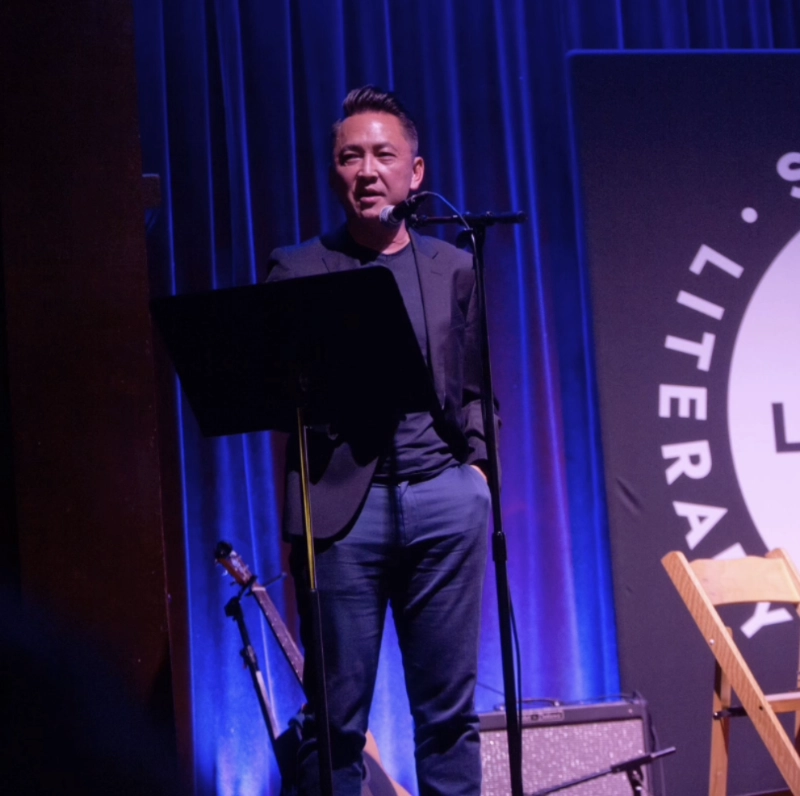
Viet Thanh Nguyen (all photos by Tommy Lau)
This was not the first time that a songwriter was inspired by the work of Pulitzer Prize-winning author Viet Thanh Nguyen. In 2016 pop punk hitmakers Blink 182 released a song called “The Last Train” that was inspired by his novel The Sympathizer. But for Viet, a song by Thao Nguyen felt different.
““To have another artist spend time with your work is obviously terrific,” Viet said, “But I don’t know Blink 182. Thao is different – I know her work, I know her, and I think we’re part of the same milieu in terms of Vietnamese American, Vietnamese diasporic artists.”
At a live LitQuake Festival performance in San Francisco, Viet gave a wide-ranging talk about belonging, grief, and the frailty of human memory. With emotion in his voice, Viet told the audience that his mother was hospitalized in a psychiatric facility when he was young. For many years Viet believed that this had happened when he was a small boy, but he recently re-read an essay he had written about it in college.
“I realized I had forgotten every single detail of that experience, including the fact that I wasn’t a small boy,” Viet said. “I was eighteen years-old.”
The experience was so traumatic, Viet explained, that it made him feel like a little boy. That was the emotional truth of the story. With empathy and grace, Viet suggested that something like this may be at the heart of the current political struggle over America’s history. The Left focuses on the often-excruciating and brutal historical truth, while the Right centers a more hagiographic and triumphalist emotional truth.

Talking about belonging with Dr. Russell Jeung
Dr. Russell Jeung, who is an old friend of Viet’s, had his own perspective on America’s politics. A deeply religious man, Dr. Jeung argued that conservatives activate white evangelicals by focusing on a limited set of issues, and avoiding broad swaths of relevant scripture.
“Politicians are smart to use fear and to use faith to mask certain issues, and to highlight certain issues,” Dr. Jeung said. “And to organize people around particular single-issue causes.”
During the pandemic, Dr. Jeung founded Stop AAPI Hate, which allowed the Asian American community to document the profound horror of the moment. The data that the website gathered was useful in convincing politicians to take the issue seriously, but Dr. Jenung pointed out that the stories were crucial for fomenting collective action.
“Having studied social movements I knew that for Stop AAPI Hate we want to provide people with frames to understand what’s happening,” Dr. Jeung says. “But we also need stories to really galvanize people to develop a sense of collective grievance, and then solidarity and change.”

Thao Nguyen
At the live show, Thao Nguyen shared a small piece of her own story in the introduction to her song, “Keep It Moving.” The song is about community dances that she attended as a young person, and her memories of the freedom and release that the music and the movement and the moment allowed in the room. Just before she began playing, Thao shared an excerpt from an essay she’s writing for her debut book coming out on Greywolf Press in 2026.
“Stateless men and women with varying degrees of fight still left in them, whom I knew personally, were free and joyful, out from under memory and worry for the evening.”

Season seven of SongWriter is made possible by a grant from Templeton World Charity Foundation.
SUBSCRIBE ANYWHERE YOU GET PODCASTS
This project was made possible through the support of a grant from Templeton World Charity Foundation, Inc (funder DOI 501100011730, under the grant https://doi.org/10.54224/31681). The opinions expressed in this publication are those of the author(s) and do not necessarily reflect the views of Templeton World Charity Foundation, Inc.