Maria Rezende + Pedro Mann: Forgiveness in Rio
Season 7, Episode 7
Poet Maria Rezende reads a poem about unrequited forgiveness, Dr. Rita Da Silva and Kurt Shaw speak about play and its relationship to polarization, and songwriter Pedro Mann performs a new song written for his father
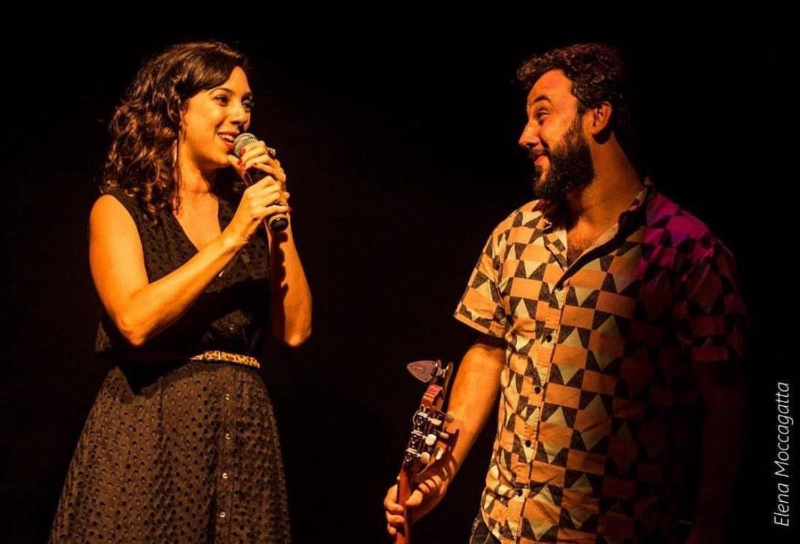
Pedro Mann & Maria Rezende, photo by Elena Moccagatta
Maria Rezende and Pedro Mann's Long Friendship
Brazilian poet and film editor Maria Rezende has been friends with songwriter Pedro Mann since she was a teenager. Pedro was in love with her younger sister then, and one day their father gave Pedro a poem. He challenged the young musician to transform the poem into a song. Pedro stayed up all night working on it.
“Oh my God,” Pedro recalled thinking, “I have to make something amazing, because I want to conquer this guy’s heart!”
It was only after he played the song for Maria’s father that he found out that the poem was actually Maria’s. Over the years since then Pedro has used many of Maria’s poems as inspiration, in a long and fruitful artistic collaboration.
Today’s episode of SongWriter features a poem Maria wrote about forgiveness. It was inspired by a moment when she badly hurt the feelings of a man she was in love with – she apologized, but he did not forgive her.
“I discovered that even if you acknowledge a mistake and ask for forgiveness, maybe that’s not enough,” Maria said. “The poem was my desperate measure to try to convince him to forgive me.” (The poem in English and Portuguese is copied below.)

Kurt Shaw and Rita Oenning da Silva
Dr. Rita da Silva and Kurt Shaw about Play, Polarization, and Forgiveness
Interestingly, when scientists Dr. Rita de Cacia Oenning da Silva and Kurt Shaw first read the poem, they thought it was about national Brazilian issues of reconciliation and justice.
“The history of Brazil is marked by a series of abuses in relation to the process of colonization,” Rita said. “And in that case, asking for forgiveness, it’s not enough.”
Kurt and Rita argue that human flourishing is connected not just with issues of reconciliation and forgiveness, but also philosophy, play, and dance. In fact, Kurt says that the Brazilian national dance of Samba contains a metaphor for forgiveness, as well as the possibility of rupture. He points out that the Brazilian word for “balance” is not a fixed state, but implies movement – the back and forth between steadiness and unsteadiness.
“That’s that swing. The Samba is: ‘I almost fall, and then I stand,’” Kurt said. “That moment of syncopation is also the moment of inviting the other person to come and dance with you.”

Pedro Mann & Maria Rezende, photo by Elena Moccagatta
Pedro Writes a Song for His Father
Pedro had a long conversation with Dr. Oenning da Silva and Dr. Shaw before he began writing his song in response to Maria’s poem. A few days later while he was brushing his teeth, Pedro realized that he wanted to write a song about his father. Pedro’s father died many years ago, after a difficult life. He was bi-polar, and sometimes violent, having suffered violence many times himself.
“The first sentence that came to my mind was, ‘Forgive me, forgive me. The pain that I caused you was the same pain that I carried inside,’” Pedro said.
The song, Pedro explained, became a vehicle for connection and repair with his father. Art is often a representation of the emotional past, but it can also be a mechanism for reconceptualizing and reframing those emotions.
Maria, who translated Pedro’s words into English for the podcast, put it this way:
“The song is a conversation that you are having with him, even if he is not here.”
*Special thanks to Kurt Shaw, who transcribed and translated the podcast into Portuguese and English, and Dolores Gutiérrrez for the Spanish translation.
Pedro's Song, in Portuguese and English
Perdão
Porque existe sim erro e existe culpa
E porque remorsos não apagam o já feito
o mal dito
Perdão existe também
e se pede
e tem esquecimento
mas não pra isso
Porque o amor constrói castelos
e gente não vive em contos de fadas
Porque o castelo pode até ser de cartas
mas que o sopro não seja meu
Porque felicidade é a droga mais cara do mercado
e pode levar uma vida pra chegar
eu te peço desculpas
todas
muitas
Porque a voz pode calar
e a sombra do erro seguir como um eco
te peço desculpas por escrito
E porque foi palavra o veneno
busco nela a minha cura
e te peço desculpas como uma súplica
como um grito
Forgiveness
Because there are faults
and there is guilt
Because regrets do not erase the facts
the done deed
the misspoken words
There is forgiveness too
and we plead
and there is also oblivion
but not for this
Because love builds castles
but we don’t live in fairy tales
Because the castle may be made of cards
but let the blow not come from me
Because happiness is the rarest drug around
and may take a lifetime to arrive
I apologize
with all my heart
with pleading hands
Because the voice may fail
and the fault keep echoing
I apologize in blue ink
And because spoken words were the poison
I make them my antidote
and apologize loud and clear
as a desperate prayer
as an urgent roar

Season seven of SongWriter is made possible by a grant from Templeton World Charity Foundation.
SUBSCRIBE ANYWHERE YOU GET PODCASTS
This project was made possible through the support of a grant from Templeton World Charity Foundation, Inc (funder DOI 501100011730, under the grant https://doi.org/10.54224/31681). The opinions expressed in this publication are those of the author(s) and do not necessarily reflect the views of Templeton World Charity Foundation, Inc.