
Isabella Rossellini & Diana Reiss + Sharon Van Etten
Season 7, Episode 11
Filmmaker and actress Isabella Rossellini shares the story of how a lecture by Temple Grandin inspired her to return to school at age 60 to study animal behavior. Marine biologist Dr. Diana Reiss explores what science reveals about animal intelligence and individuality. Rock star and songwriter Sharon Van Etten transforms Isabella’s story into an original song called “for Isabella.”
A lightly edited transcript of the episode is at the bottom of the page.
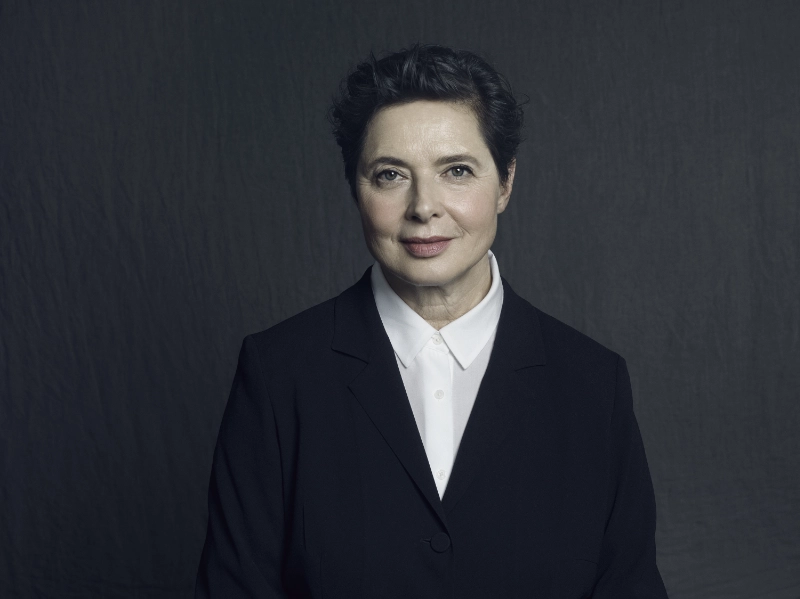
Isabella Rossellini Heads Back to School
Filmmaker and actress Isabella Rossellini was in a wheelchair. Isabella was born with severe scoliosis, and she had a second surgery to treat it when she was 60 years old. Still, determined to stay active as she recovered, Isabella arranged to see noted ethologist Temple Grandin speak at Hunter College.
Ethology, the study of animal behavior, was a lifelong passion. In fact, ethology was what Isabella had imagined studying when she was young, but there were no universities offering degrees in ethology in Italy at the time. After Temple Grandin’s talk, Isabella noticed that Hunter College had recently opened a graduate program in ethology.
“There were people handing out pamphlets saying that Hunter College just opened animal behavior and conservation,” Isabella recalls. “I said, ‘This is what I’ve always wanted to do all my life!’”
Isabella signed up, and the next week, still in a wheelchair, she went to her first class. Since then, Isabella's fascination with animals has led to a series of creative and educational projects, including her long-running video series “Green Porno,” and her one-woman shows “Link, Link, Circus” and “Darwin’s Smile.” These projects were in part creative refractions of what Isabella learned in class, especially those taught by Dr. Diana Reiss.
“I always said to Diana that ‘Link, Link Circus’ is really [her] class, translated into a theatrical form,” Isabella says. “There was so much information that [she] taught us that I’ve used.”

Dr. Diana Reiss, photo by Elizabeth Nolan
Dr. Diana Reiss and Animal Welfare
Diana has spent much of her life exploring interspecies communication. A professor, a scientist, and an advocate, Diana underscores that while conservation is important, so is animal welfare.
“People often get this mixed up,” Diana says. “Conservation is a numbers game, based on how many individuals do you need to keep a population healthy. Welfare is concerned for the individual animals.”
One of the strategies Diana uses to activate collective political engagement is to elicit empathy for individual animals. She points out that Humphrey, a humpback whale who she helped rescue in the San Francisco Bay, was wildly successful in attracting both media attention and political action. Diana is particularly passionate about preserving The Marine Mammal Protection Act, which helped populations of whales and dolphins stabilize.
“We’re getting threats to eviscerate this act,” Diana says. “It’s up to the public to start writing to senators and congresspeople to say we don’t want this eviscerated.”

Sharon Van Etten, photo by Devin Oktar Yalkin
Sharon Van Etten Responds
The song written in response to the narratives from Isabella Rossellini and Diana Reiss is by Sharon Van Etten. Sharon, who is an actor as well as a rock star, is a longtime fan of Isabella’s work.
“Isabella takes on very challenging roles and says so much with so little, from very flawed-yet-vulnerable characters,” Sharon says.
The song – titled “for Isabella” – was written as a tribute and as a kind of emotional purification ritual. Sharon often engages dark emotions in her songs, as an act of unburdening and release.
“Because I’m able to get it out, because I’m able to connect with other people, it helps me feel less alone,” Sharon says. “It’s a catharsis, an exorcising.”

Season seven of SongWriter is made possible by a grant from Templeton World Charity Foundation.
SUBSCRIBE ANYWHERE YOU GET PODCASTS
Transcript
Part 1: Isabella Rossellini
Ben Arthur
(Voiceover)
From PRX, this is SongWriter, the podcast that turns stories into songs.
My name is Ben Arthur.
Season seven is made possible by a grant from Templeton World Charity Foundation and focuses on elements of human flourishing like polarization, empathy, and in today’s episode, animal intelligence.
Today, we have a brand new song from Sharon Van Etten, a conversation with Dr. Diana Reiss about animal behavior, and an interview with one of the most fascinating and surprising people I’ve ever met.
Isabella Rossellini
My name is Isabella Rossellini and because I’m old I have many facets, as you say.
So I mostly worked as a model and as an actress, but I always loved animals.
So when the work slowed down as an actress and as a model because they prefer them young, I came back to university at Hunter College to take my master degree on animal behavior and conservation.
When I had my appendix operation, I think I was five or six, my mom gave me a dog, a little Maltese called Youppi.
I call Youppi.
Youppi in French means hooray, happiness, wow.
And Youppi was my first love, you know, and then after Youppi I had another dog called Nando until I was 25.
So when Nando died, it was a really incredible loss because I didn’t remember my life without Nando.
It was a little dachshund.
And maybe I was closer to Nando because Youppi was given to me when I was very little and Nando when I was a little older.
And also it was at the time of my first operation where I had to be in a hospital and in bed for six months, immobilized completely.
And the rest of the time is another six months at home.
So Nando was my toy, my companion.
He was delighted I was in bed because that’s what he wanted to do all day.
Just sleep.
Dogs sleep 20 hours a day.
And probably I would have not been allowed to sleep in bed with a dog, but because I was a sick child, I could, of course, let Isabella have Nando.
I remember, I mean, I’ll give you a little episode.
I came home one day and I immediately sensed that there was something wrong.
And I don’t remember the detail, but I remember this incredible panic and calling my dad and my dad coming from work.
We looked for him everywhere, but I knew instantly that he was sick.
And then I remember how afraid I was to lose Nando and how I brought him sweaters with my — I would wear the sweaters and then bring the sweater.
He stayed at the hospital that had my smell because I understood that smell for him was important.
Nando recovered.
I came back home.
But there was a real connection.
I mean, even in that moment where I immediately knew there was something wrong, or sometimes I just looked at him and said, “Oh, you’re thirsty.”
How did I know that?
My father gave me when I was 14 years old — he knew I loved animals — and he gave me the book by Konrad Lorenz called King Solomon’s Ring.
That was a book that Konrad Lorenz wrote about the science that he had founded called ethology, which was animal behavior.
And I read the book and that was a moment, aha moment, said, “Ah, that’s what I want to be. I want to be like Konrad Lorenz. I want to be an ethologist.”
In Italy, when I was ready to go to college, they didn’t offer ethology.
There was biology, zoology, but the science of ethology, animal behavior, is relatively new.
So they offered it at, I think, at Cambridge or Oxford, in America, in Florida.
But I lived in Italy and English was my second language.
So when I was in my twenties, I just didn’t think I could enroll.
Plus there is two years of the undergraduates before you can even get to study what you want.
So it just seemed when I was 18 or 19, an impossible task to go all the way to a master degree.
Ben Arthur
(Voiceover)
Also, there were other opportunities for Isabella, who began her work as a foreign Italian correspondent in New York, moved on to modeling, and then acting.
I’ve actually found it’s quite difficult to sum up Isabella Rossellini’s storied career without somehow sounding as if you’re underselling it.
Suffice it to say that she’s won an Emmy Award, a Golden Globe, and was just nominated for an Academy Award for Best Supporting Actress for her performance in Conclave.
Through all of this, her interest in animal behavior never waned.
And so when a surprising opportunity presented itself, she jumped at the chance, even though it was at a moment of profound vulnerability.
Isabella Rossellini
So I was born with a deformity of the back. It’s called scoliosis. It’s very common, but mine was very severe.
I had two operations — one when I was a little girl and one when I was 60.
The second one was a major operation where they fused 17 of my vertebrae.
So I had a very long period of recovery.
That was six to eight months where I couldn’t work.
Plus, I was old to be a model and an actress.
So I just didn’t know. I didn’t know if, once I recuperated my health, what my life was going to be.
Ben Arthur
(Voiceover)
It was at this moment that Isabella heard that Temple Grandin, the noted ethologist, animal behavior expert, and inventor, would be speaking at Hunter College.
Isabella Rossellini
I came in a wheelchair with a nurse.
She was a student nurse here at Hunter College, and that’s how she learned about it.
She knew that I loved animals, so she said, “Oh, let’s go there.”
There were people handing out pamphlets saying that Hunter College had just opened a program in animal behavior and conservation.
And I said, “Oh, this is all I’ve wanted to do all my life.”
And she said, “I’ll sign you up.”
The next day — I think it was January — and the classes started a week or so after.
She brought me back in the wheelchair.
The first classes I attended were in the wheelchair.
Then I got better.
And so here I am now, walking.
Ben Arthur
And so began Isabella’s work with Dr. Diana Reiss.
In fact, it was Diana who first encouraged Isabella to write a script about animal behavior.
Isabella Rossellini
Well, I always said to Diana, you know, Link Link Circus really is your classes translated into a theatrical form.
There was so much information that you gave us that I’ve used — bits and pieces — but I draw everything because it has to be visual.
You cannot, in class, you can verbalize and you can tell.
But when you go to the theater or you’re in films, you cannot just talk.
You have to illustrate.
So that’s why I draw and made a series of short films and also make some videos.
All my monologues are heavily illustrated with videos and photos, and generally comical too.
And the reason it’s comical is that animals make me laugh.
I find them funny.
I find them so absurdly funny.
You know, we always grow up saying, “There’s a mommy and a daddy and a baby.”
Then all of a sudden — they are hermaphrodites, they are sequential hermaphrodites, they change sex in the middle of their life.
Anything goes.
And so it’s amusing.
Plus, they do these things that are so mysterious.
We were in the elevator coming to the studio for this interview.
We were talking about whales singing together, and I thought of wolves and how they howl together.
Why do they do that?
We still don’t know.
But of course it’s something more than just…
I think it’s communicating.
I mean, how could they evolve it if there wasn’t a purpose for it?
There is a purpose.
We just haven’t found out what it is.
Ben Arthur
Isabella’s theater productions on animal behavior include Link Link Circus and Darwin’s Smile, which is about Charles Darwin’s study of animal and human expressions using the then-new technology of photography.
Isabella Rossellini
To take a photo, the camera demanded a very long exposure — as long as 60 seconds, which is quite long — but still you could capture something that couldn’t have been captured before.
For example, he worked with a photographer called Rejlander who photographed a child crying.
The baby was screaming, and they photographed it.
That photo sold millions of copies, apparently, in the late 1800s.
Everybody had that photo because it was a very familiar expression.
Everybody had seen a baby angry, crying.
Yet nobody had captured the moment.
There were paintings — an approximation of it — but that photo was completely what it was.
And Darwin thought that photography could help him understand the expression of emotion.
And he wondered something very simple.
He said, “If I smile,” he would photograph people smiling, and he would send the photos all over the world and say, “What is this person doing?”
And people said, “Smiling. Happy. Content.”
Then he would send photos of people frowning or looking angry, showing teeth, and they would say, “They’re angry.”
So you see, some expressions are culturally shaped.
But others — like a smile — are understood all over the world.
It’s the same smiling in Japan, in Germany, in America.
Why is that?
It has been shaped by evolution, just like our bones and our hair.
But Darwin observed children who were born with certain expressions — smiling, crying — and certain others that had to be learned.
And he also included animals.
There was, Diana could tell you better, a movement in America called behaviorism.
They really said you cannot talk about emotions because it’s such a private experience.
So they became behaviorists, saying we can only witness the behavior.
If a dog shakes his tail, we can’t say he’s happy.
We can just say: he shakes his tail every time he sees his owner.
Darwin didn’t have this problem.
This was a problem that came years later.
He was completely convinced that animals had emotions and expressions.
And he gives many examples.
You know, we tremble when we are afraid.
Animals do it too.
We scream when we are frightened or surprised, and animals do too — they emit a very sharp sound.
So he said there are parallels, and he had no doubt that animals had emotions.
It came much later that people said animals didn’t have emotions.
But he wrote to his grandmother, because he went to the zoo quite often, observing animals and doing experiments.
He would bring a fake snake to see if the animal — even if it was fake — would react with fear when they saw the snake.
He was doing very funny, easy, simple experiments.
He writes to his grandmother about visiting the zoo.
The keeper of the orangutan named Jenny shows Jenny an apple, but she wouldn’t give it to her.
So he writes to his grandmother, “Jenny threw herself on the floor in a tantrum that looks exactly the same as my children when they are frustrated.”
And then the keeper said, “Jenny, stop doing that. If you stop growling, I’ll give you the apple.”
And he writes, “Darling, I think she understood every word of it.”
Because she stopped, and the zookeeper gave her the apple, and she sat and ate it with great, great satisfaction.
But he was looking at the behavior.
He said there are so many parallels to the way my children react when they are frustrated.
Ben Arthur
(voiceover)
To me, this story connected Charles Darwin’s work with Isabella’s — not only in Link Link Circus and Darwin’s Smile, but also in her hit video series Green Porno.
In each episode of Green Porno and its many offshoots, Isabella uses costumes, stories, and jokes about sex to teach the audience about the extraordinary world of animals.
(to Isabella Rossellini)
It seems to me that your work communicating the worlds of animals and connecting them to us — I’ve watched Green Porno videos of you dressing up as a shrimp, for example — seems like you are pulling us closer and closer to a recognition of our connection with animals, and the depth of their intelligence and emotion.
And so I guess, in my mind, that story where Darwin sees his daughter in this animal in a cage in a zoo, where he gets into the cage, where he hands over a mirror, is kind of extraordinary and profound and related to your work.
Am I overthinking it, maybe?
Isabella Rossellini
(instantly, laughing)
Yes.
Ben Arthur
(laughing)
Okay, beautiful. Tell me why.
Isabella Rossellini
So, I like animals.
And I always had the impression, when I was a little girl, that they had emotion — that my dog and I were connected by affection and understanding of each other, loving each other’s company.
And I was told, “No, the dog follows you because you’re feeding him.”
I didn’t feed him.
So many times it was my mom feeding him, and the dog was still following me.
So it really comes from very simple things.
Not so much about where is religion leading us, and what is morality, and where is free will versus instinct.
I know that it touches those questions, but that’s not the part that I’m interested in.
I am just interested — I like animals.
I like their company.
I like to observe them, like other people might like Harley-Davidsons and fix up a motor.
So it’s very simple.
It’s not so philosophical.
I’m an actress and I’m an entertainer.
So, for example, Green Porno was really meant to entertain and to make people laugh.
There is a component of comedy and laughter.
I don’t see myself as somebody who wants to convince another person that this is my way and you’ve got to come and you’ve got to admit.
Actually, I don’t have many answers.
But it’s the wonderment that it is wonderful.
So if anything, I would like to invite people to be wondering like I do.
Ben Arthur
(Voiceover)
Still, because I’m a very annoying and stupid person, I pursued this idea and I showed Isabella a video I had recently seen of a rooster who seemed to be mourning his dead mate.
Isabella was not swayed and told this story in response.
Isabella Rossellini
It was Saturday, and that’s when we opened the farm, and it was a dead chicken.
And I saw the dead chicken as the people were coming to see the marvelous farm.
I don’t know how it was killed.
I think it was a hawk who got her.
The hawk — they just eat the head.
They leave them.
I opened the cages to get the chicken around, and they all ran to this dead chicken and they started to eat it — like carnivores, like what you see in National Geographic, lions eating a zebra.
I was so embarrassed because everybody was saying, “The chickens are so kind,” and “You love such a…”
And they were cannibals.
I didn’t know how to justify them morally.
So, I don’t know.
Do they feel grief?
I don’t know.
Ben Arthur
(Voiceover)
At the same time, Isabella does not dismiss the idea that animals have emotions.
And she shared a story about some sheep on Mama Farm.
I should mention that among Isabella’s other endeavors, she founded in 2013 a 28-acre farm in Brookhaven, New York, that aims to support the next generation of environmental stewards through education and preservation of biodiversity.
Isabella Rossellini
I’ve seen a mama sheep die and a baby being very attached even to that mama.
It was difficult to separate them and to bury the mama because the lamb wanted to be with the mama, and then cried and cried and cried and called for the mama.
I think that in the farm world there is a certain amount of roughness with the animals, traditionally.
And so I was told that lamb is too big now; it should be separated from the mother because she has to wean off drinking milk.
So I obeyed, and I separated them — both in two different fields, but far from one another, about a mile.
And they cried.
Mama and babies.
Then I called the vet and I said, “I don’t know. I was told by my neighbor, a shepherdess, that I have to separate mama and baby because otherwise they keep suckling, and now they have teeth and the mom might get an infection.”
And he said, “Oh no, don’t worry about that. Why don’t you put them back together?”
And I did.
I ran.
I got the baby on my car and drove it back to the mother.
And they were so happy to find each other.
And that’s the mama that eventually died.
And she died because she ate a snail.
There is a snail in North America, where we live, that has some toxic thing that affects the neurology of the sheep.
For two or three days she started to walk as if she was drunk.
I called the vet.
We tried everything, but eventually she died.
Ben Arthur
(Voiceover)
As I understand it, at heart Isabella is a scientist.
She will not take a position on something that she does not have the evidence for yet.
And in the meantime, she is here to share passion and interest and excitement about her work and about her observations in the way that she knows best.
Isabella Rossellini
There isn’t a real mission, you know.
I mean, that’s my job as an actor, as a director, is to be a storyteller.
So I translate what is written in scientific terms into another format, which is entertaining.
I always say I want my audience to have two reactions.
First one: ha ha ha — laughter.
And then: oh.
Like, oh, I didn’t know that.
Oh, that is really incredible.
That is really wonderful — wonderment.
So I try to capture what makes me laugh about animals and tell the wonderment of any possibility that happens in nature.
Now, it could be that some people don’t respond to it, and it could be that some people respond to it, and that’s how you find an audience.
And I come from a film business, so I think narrative and telling stories was part of how I grew up.
It came naturally to me.
It wasn’t a decision — “How am I going to tell a story?”
I thought you had to tell the story, because everybody in the family was telling stories.
Ben Arthur
(Voiceover)
As we were chatting at the end of the interview, Isabella had a last thought about music.
Isabella Rossellini
I want to say something about music and Darwin.
Darwin writes that probably music came before language.
That probably we serenaded before we could say, “I love you.”
And he based that on the fact that a lot of animals sing, and that song also had this deep impact on us.
And also it’s a language that is by everybody.
Transcript
Part 2: Dr. Diana Reiss
Ben Arthur
(Voiceover)
And now a conversation with Dr. Diana Reiss about animal behavior and intelligence.
Diana Reiss
I’m Diana Reiss.
I’m a marine mammal scientist and a cognitive psychologist, perhaps an odd combination.
I was always sort of, as a kid, interested in science and the arts.
I actually went to an art college in the beginning, Moore College of Art in Philadelphia, where I was from.
And then I got involved in theater.
Art leading into theater and stage design.
And then for a number of reasons, I got more interested in animal cognition and trying to understand the animal mind.
I was very lucky.
I actually did my PhD research while I was at Temple University, but I got a grant from the French government.
I was able to study dolphins and start sort of feeling out some ideas I had for how we might decipher what dolphins are doing in their own forms of communication.
And I also got interested in interspecies communication, meaning how we might use some kind of shared code to communicate back with dolphins.
Now that may seem far-fetched, but it was a time period in the ’80s, in the early ’80s, where people, a bunch of pioneers, started looking at: can we use sign language with chimpanzees?
Because they gesture, and they developed these really effective means of learning that you could use signs, and you could get information about the minds of these animals because you gave them a voice.
So I was thinking about all this and I decided I’m going to try to create an underwater keyboard for dolphins.
The keyboard was a nine-by-nine key matrix.
So it was three rows, three columns.
And they had different visual keys, different visual shapes or symbols on them that were white on a black background.
If the dolphin hit a key, pressed a key, they would hear a computer-generated whistle.
So it might sound like [whistle].
Or if they heard one whistle, it would get them a ball if they pushed a triangular shape that looks nothing like a ball.
They were called non-iconic symbols.
If they hit the shape for a ball, no matter where it appeared, they’d hear the same whistle, get a ball.
And so we gave them control.
The question was what would happen if we gave them choice and control, not whether we could train them, but we gave them that opportunity to explore the contingencies of symbol use.
And no one had tried this with dolphins, and I thought, wow, we’re working with another big brain.
If we were working with an alien species, I wouldn’t want to train them, I’d want to find an interface.
So when we did this, they rapidly started to imitate the sounds, but they did more.
Not only did they imitate them quickly, but they started using them in the appropriate context.
So we started hearing balls being imitated, the ball sound, when they were approaching a ball or playing with a ball.
They never did it when they were doing any of the other objects.
They even combined the ball and ring into one continuous whistle — ring and ball — when they were playing this new game they invented, where they tossed the ball and ring up in the air and caught it.
When I was a graduate student and I was asked to work with this young dolphin, that I named Cersei, my first job there, aside from trying to do my doctoral research, was to teach her to stay in front of me, or station is the term we used.
And I had a bucket of fish, and in the bucket were mackerel that were about twice the size of the small dolphin’s head.
And I thought, there’s no way this dolphin’s eating this giant mackerel.
So I promptly cut it up into heads, middles, and tail sections.
And Cersei ate the heads right away, ate the middles perfectly.
She spit out every tail.
And I looked at it and I thought, wow, there’s this big fin at the end.
Maybe she doesn’t like that.
I cut it off.
I joked that she had trained me beautifully to cut the fish just the way she wanted it.
Cersei’s really smart.
These animals have big brains, big complex brains like us.
And she quickly learned to station when I gave her the bucket and a signal to station.
In the course of this, it took me about a week or so to correct it when she left.
And I used what we call a timeout.
What it meant was if she left before I gave her the signal, I would back away from the pool, maybe 10 or 15 feet, taking the bucket with me.
And it broke the possibility that we could be social together or she could get a fish.
And she learned really quickly that this timeout meant something was wrong.
And it corrected her and she learned.
Well, everything was going great.
And at one point, I gave her, by my error, an uncut tail.
I made a mistake.
I gave her an uncut tail.
And she looked up at me, and she spit it out, and she made a beeline to the other side of the pool and took a vertical position and just stared at me.
Was she giving me a timeout, really?
It was about, you know, 10, 15, 20 seconds.
She came back, and I continued to feed her properly cut fish.
And she stayed the rest of the time.
But I wanted to test: is it possible she’s really using this?
So I purposely, over the next couple of weeks, did one uncut tail every so often.
I did it three other times.
And every time I gave her an uncut tail, she would do that, not other times.
So this was this aha moment for me because I felt, wow, she’s using something that functionally means something’s wrong.
I don’t know what it meant to her.
But she used it in the right context.
And at that moment, I realized, oh my gosh, this is a magnificent mind to be dealt with.
And it really changed my perspective in some fundamental way that these were such intelligent animals.
I had to really figure out something that would work and to be able to show more of a reflection of these minds.
Ben Arthur
(Voiceover)
Dr. Reiss is a scientist, but she is also an advocate, not just for the conservation, but the welfare of animals.
Diana Reiss
As a scientist designing experiments to show us reflections of their minds, I feel again, it’s my responsibility then to talk about this through scientific publications, but then apply it — or what I say, what I call translating it — into policy decisions, because I think once you can show what animals are capable of, because they can’t tell you themselves outside of what they show in these experiments, then I think hopefully we’ll be able to get people to empathize more with them.
With increased empathy, you’ll often get more action for their protection.
And I think these animals need greater protection.
We need to think about the conservation of them as populations.
But I think it’s also important to think about their welfare as individuals.
People often get this mixed up.
Conservation is a numbers game.
It’s based on how many individuals do you need to keep a population healthy and surviving.
Welfare is concern for the individual animals.
And we see this, and more recently, over the past years, I’ve been working to stop the horrendous dolphin drive hunts in Japan.
In fact, I was the scientist who told the filmmaker Louie Psihoyos about the work that led to The Cove, the film about the dolphin drive hunts.
It’s often empathy that drives policy changes.
One of the things that’s often a challenge for us as scientists is to think about what kinds of questions might you ask to get a good sense of another animal’s mind.
And with dolphins at the time, we knew that they had large complex brains.
And then many years later, there had been work done on showing mirror self-recognition in our closest living relatives, the great apes.
We did a few studies.
One was suggestive.
And then when I moved to the New York Aquarium and was working with them, we did a more definitive study showing, wow, they have this capability too.
And then we looked at young dolphins when confronted with the mirror.
And guess what?
They show it younger than humans, much younger than humans.
And it’s not that they’re smarter, it’s that their whole developmental trajectory is at an accelerated pace.
They have to hit the water swimming.
But to see it in a seven-month-old when humans don’t show mirror self-recognition until between 18 and 24 months of age, that’s pretty jaw-dropping.
Ben Arthur
(to Dr. Reiss)
It’s fascinating, I guess, to me that you were able to do this work, which is reaching across the animal-human barrier to communicate.
There’s this, speaking of mirrors, mirrored effort that you are also, it seems to me, very good at, of taking the scientific work and reaching out to the larger audience to move humanity.
Diana Reiss
Well, thank you for saying that.
I try to find that common denominator, that place where I can connect.
And I think people across bipartisan boundaries care about animals, essentially.
Most people in this country have pets.
And if you can reach them at that level and say, these are individuals.
And you see it happening when we do rescues.
I was involved in a big whale rescue many years ago.
A big humpback whale came into San Francisco Bay.
We called him Humphrey.
And I was working with the National Marine Fisheries Service and NOAA and the—
I was part of the rescue center in California.
We got calls from all over the world about this one individual.
It’s kind of like the ET phenomenon.
There’s one lost alien and people want to help, yet we have all these marine mammals who are getting injured by ship strikes or getting entangled in nets off of our coast.
And it’s hard to get people to wrap their heads around that.
So I try to zoom in on those individual animals and talking about those, because they make up these populations.
And right now, since I’m here, I’m going to make a pitch that we’ve had something called the Marine Mammal Protection Act for 50 years, over 50 years, that really has helped these populations of whales and dolphins and other marine creatures come back.
Their numbers are coming back and they’re surviving.
And now we’re threatened, we’re getting threats to eviscerate this act.
Get rid of all the protections that we have.
Again, it’s up to the public to start writing to senators and congresspeople to say, don’t want this eviscerated, we need protections.
And it’s a time now where there’s so much danger in the oceans for these animals.
There are certain senators out of Alaska, particular senator out of Alaska is putting in a bill that will get rid of funding for the Marine Mammal Commission, which oversees this, to really destroy or gut, the Marine Mammal Protection Act that we’ve worked so hard to do.
And a lot of this came out of efforts by many scientists and others working on conservation over 50 years ago.
I get very emotional when I talk about this.
You know, when we look at them as individuals and try to understand that other mind, you know, as human beings, there are a lot of others around us from other nations, from other backgrounds, and we have to overcome putting that wall between us and other, whether it’s other humans that are different from us or other species that are different from us.
To me, there’s this richness in other and the ability to appreciate the other and also protect them, whether it’s them as individuals or their environments.
Transcript
Part 3: Sharon Van Etten
Ben Arthur
(Voiceover)
Now for the song written in response.
Sharon Van Etten
My name is Sharon Van Etten.
I feel like I’m a different person every time I check in and work on a new project.
But in this moment, I’m a mother first and an artist.
And I have acted, but at the moment I’m mostly trying to focus on family.
Ben Arthur
(To Sharon Van Etten)
You said in an email that this project meant the world to you.
Why?
Sharon Van Etten
Between Isabella and also the process of writing and thinking about life transitions as a parent.
I mean, there’s a lot of overlapping themes in my life from things I’ve done to things that I want to do and aspire to do.
And I just really connected with different phases in life and making pivots, and as well as really holding Isabella in a high regard.
And also to be asked to talk about process.
It’s something that I’m still learning how to hone.
That all means a lot to me.
Ben Arthur
Tell me about your relationship to Isabella.
Sharon Van Etten
I’m a fan of Isabella’s acting.
Isabella takes on very challenging roles and says so much with so little.
And from very flawed yet vulnerable characters, I think that she has a way of making you connect with her on a personal level, and also take you to a whole other universe.
One of the main things that she can do that I have not yet been able to achieve is to transcend just the medium and take you to this whole other universe.
Whereas where I am is allowing people to be very much in tune with what they’re feeling and letting you go to those dark spaces.
Maybe that is where I connect with her work as well.
She lets herself go there.
But I think she transcends that into parallel universes and places that we don’t have to go.
Ben Arthur
Another connection that I sort of imagine between you and this story in particular is that you plan on going back to school to get your degree in psychology.
Sharon Van Etten
Going back to school has been an ongoing challenge in my life.
I actually went to Brooklyn College when I was taking a hiatus in 2015–16, and around that time I found out I was pregnant.
And so after going for about a year off and on through pregnancy and things like that, life changes.
I am still chipping away at a degree that I haven’t finished.
Ben Arthur
I hear that.
And also: the story that she’s telling anyway is at 60 years old and in a wheelchair, she was like, “Sign me up today.”
I feel like there’s some — yeah, you might have some time, I guess is what I mean.
Sharon Van Etten
That’s the hope.
Ben Arthur
I’ve only heard the song in demo form, but there’s a question that I was immediately drawn to and that Diana Reiss was drawn to, which is who you’re addressing.
Sharon Van Etten
As I was working on the lyrics for this, I actually tried to bounce back and forth between, you know, is it perspective of — and I don’t want to sound too literal while speaking to, because I have a dog, speaking to this amazing being that has definitely changed my life and has made me think of the world in a new way.
I mean, from also having a kid and just bringing life into the world while also trying to understand something other than yourself and your own processes.
So I went back and forth to the interview with Isabella, like everything that she said about her first connection as a child, seeing my child with our sweet pup.
He’s right here with me actually.
He’s behaving.
Realizing how much they give to us that we may not always acknowledge.
Ben Arthur
Diana’s guess was that you were talking about a beloved pet.
I wondered if you were also in part talking to Isabella herself.
Sharon Van Etten
I dare not try to walk in her shoes, but I tried to connect with her story on my own level.
So hopefully she feels honored in some way.
Ben Arthur
You, in the first verse in particular, are talking about a lot of intense danger.
Tell me about that.
Sharon Van Etten
I feel like when we go to these darker places, sometimes we look inward and sometimes we look out and sometimes we’re waiting to be found by someone, something that can get us out of it.
Ben Arthur
There was a moment I heard you describe where your mom listened to one of your songs and got scared because you were describing things that are so intense.
And I wondered about that edge in the song and I also wondered about how it feels to be a mom yourself.
Sharon Van Etten
I’m only nine years into being a parent.
I think I’m still learning and I take as much joy in it as I am terrified.
I think back to what my mother said about — she’s been very nervous about all the content of my songs and what I write about and how dark I can go.
But I remember communicating to her that because I’m able to get it out, because I’m able to talk about it, and because I’m able to connect with other people, it helps me feel less alone and helps me get it out of my system.
And it’s a catharsis in exercising that I’m still figuring out because the joke is I’m actually in a really good place in my life.
I’m happily married.
I have a beautiful kid.
[Sharon’s dog barks.]
Lindy! Sorry.
I’ll let him out if he keeps doing that.
So just as a silhouette, that person that struggles learning how to use my music as an outlet, it can be a superpower.
I have to even filter myself because some of my demos are so dark that I don’t even share them because it’s more for me.
Like, I got it out.
It’s no longer inside.
And now it exists in this little folder that I can just put away.
But as a mother, and seeing what my kid is going through now, even at age nine, my heart goes out to him as he’s learning how to communicate and find his own vocabulary for things that, you know, he’s going through.
Just being a kid is so hard.
Like, I forgot that until I had a kid, you know?
Ben Arthur
It really is.
And it’s hard to watch someone go through it.
All of the stages are sort of sweet and heartbreaking at the same time.
But it does strike me as an artist myself that there can be a disconnection between what you need to say and where you are.
Do you ever run into that?
Sharon Van Etten
When you look back on earlier work, they’re all versions of who you are and you connect with that on some level.
I even, when I talk to fans that I met from that long ago, I mean, I think even they feel so far removed from the time, still connect, you know, connect to who they were, you know, as artists to fan relationship goes.
And I just feel like we get to witness each other in this community grow and evolve.
And as a person that is trying to evolve, you have to have some compassion for who you were, who you are becoming, and for all the things that, you know, you will hopefully grow to be.
Going back to find old letters from fans that also were connecting to my music at that time, I connect both to the fan that’s connecting in such a vulnerable way as much as when I was writing in that way as well early on.
[Sharon’s dog barks.]
Ben Arthur
(Voiceover)
At this point, and especially considering the subject of today’s episode, it made more sense for Sharon’s dog to spend the rest of the interview on her lap.
Sharon Van Etten
This is Lindy.
Ben Arthur
Hi Lindy!
You are still in-process on the song.
How’s it coming along?
What do you still have to do?
Sharon Van Etten
Well, for the mixing, I have my friend Dan Knowles, who co-produced We’ve Been Going About This All Wrong with me.
And he was my front of house engineer for a long time.
He’s got an incredible ear and he totally gets my taste.
And so I tracked it in my home studio and I sent him a bunch of notes because I don’t have that kind of talent.
He sends me a mix and then usually then I’ll hear more if I need to perfect a vocal or if there’s a lyric that drives me crazy, I can kind of edit it a little bit.
He’s very excited.
He’s gonna be mixing it this week.
Ben Arthur
What should I have asked you about?
What are you interested in talking about?
Sharon Van Etten
Well, the timing could not have been better for you to ask me to do this because I’m in a place, as I was alluding to earlier, that I’m just in a really good place and I haven’t been writing a ton.
And usually when I do write, it’s because I’m going through something heavy and I’ll sing stream of consciously and I’ll just record something with music and my stream of conscious vocals.
And then I’ll listen back to this very open-ended piece and I’ll write down the phrases that I didn’t realize I was saying and then make sense of the lyrics and then kind of analyze what it was I was going through.
But one of my goals this year has been, I just want to sit down to write lyrics.
I haven’t really done that with my personal process.
I don’t sit down just to write lyrics before I ever write music for something.
And that’s been on my list this year of things to work on.
And so being able to sit down and write lyrics in response to the interview and also just about connections with animals and life changes, I found myself writing more than I meant to.
I think I had four or five demos in the process that I had to narrow them down to which I felt was the strongest for this situation.
But once I started writing the lyrics, I unlocked something in it.
I finally got my creativity flowing again.
So I wanted to thank you for that opportunity.
Ben Arthur
(Voiceover)
This is a brand new song by Sharon Van Etten titled "for Isabella."
Sharon Van Etten
(Song: “for Isabella”)
[lyrics/music]
Ben Arthur
(Voiceover)
That was a brand new song titled "For Isabella," written and performed by Sharon Van Etten, with additional production and mixing by Daniel Knowles.
Special thanks to Diana Reiss for all of her work behind the scenes to make this happen.
And also to the kind folks at Hunter College for hosting the conversation with Isabella.
Deep gratitude also to Sharon’s team, Zeke Hutchins, Kelly Russo, and especially Amy Kaplan, who suggested Sharon in the first place.
The next episode features a true-life story about a near-death experience from Sonia Khan and Ian Lovett, a conversation with Dr. Brianna Morgan about caregiving, and a brand new song written in response by composer and multi-instrumentalist Tom Marsh.
If you want to read more about today’s episode, go to PasteMagazine.com and search for Ben Arthur. And while you’re there, check out the Paste Podcast or get it wherever you get yours.
Finally, thanks as always to Rob Reinhart and Acoustic Cafe.
This project was made possible through the support of a grant from Templeton World Charity Foundation, Inc (funder DOI 501100011730, under the grant https://doi.org/10.54224/31681). The opinions expressed in this publication are those of the author(s) and do not necessarily reflect the views of Templeton World Charity Foundation, Inc.