
Season 7, Episode 1

Beth Macy
In her hometown of Roanoke, Virginia, journalist and bestselling author Beth Macy (Dopesick) took the stage to whoops and hollers from a theater full of neighbors and fans. She was there to share a story from her new memoir, Papergirl, and share the stage with her favorite band, Palmyra.
“When [Ben Arthur] called me and talked about the structure of the podcast series, I was like, ‘I know a band!’” Beth said, as the audience laughed. “And he was like, ‘Your kid’s band?’ But he listened to [Palmyra] and he loved it.”
Beth’s story was about her family. Most of Beth’s siblings lean MAGA, and she has a brother-in-law who likes to describe himself as “deplorable.” Papergirl is both a thoughtful history of how America got so polarized, and a very personal window into Beth’s struggles to keep her family connected and communicating.
“Our oldest son Max announced that he was getting married to the young man that he had been dating, and no one in my family of origin offered a congratulatory word save a single “like” from my oldest sister Terri on Facebook,” Beth recalls. “Our youngest, who’s now a professional musician, had recently come out as non-binary.”
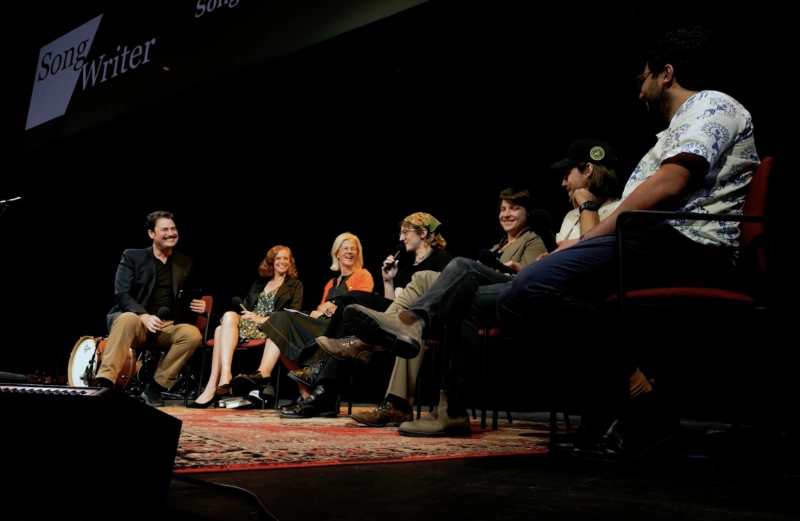
In conversation at The Grandin Theatre
Perhaps not surprisingly, conservative members of Beth’s family have strong opinions about gay and trans folks, and the issue is so personal for Beth and her children that talking about it can be difficult. After Beth’s reading, the University of Virginia’s Dr. Rachel Wahl took the stage to talk about polarization. Dr. Wahl recalled that she began studying the subject soon after the “Unite the Right” rally in Charlottesville. Dr. Wahl believes that sometimes the best way to stay connected is by avoiding subjects where we disagree. Moreover, she said, arguing about sources and facts may be a waste of time.
“Most of the time it is not helpful to try to prove that your facts are better,” Dr. Wahl said. “What matters more is why a source seems true to somebody. I think it’s worth asking questions and getting curious.”
This can be challenging, though, when people hold ideas that negate, or even denigrate, someone’s personal identity.
“It can be very difficult if your identity and your full enfranchisement as a citizen is dependent on the way [a] political issues goes,” Dr. Wahl acknowledged. “However, at the same time, when it comes to the way that people seem to be persuaded, nobody wants to listen to somebody who they don’t feel likes them.”


Palmyra, live at The Grandin
Palmyra’s guitarist and singer Sasha Landon, agreed, both in how difficult these situations can be, and also how necessary it is to try to bridge the gaps. The band is keenly aware that their audience contains a lot of different types of fans. Many of the younger listeners seem to have been drawn to the songs in part because of Sasha’s non-binary identity, while older fans are more likely to be bluegrass enthusiasts, happy just to see a young band playing old time music.
“I think that’s such a key point of what our [new song] is touching on: How do we meet people where they’re at?” Sasha asked. “How do we meet the places where they’re at with radical love and patience?”
Palmyra’s newest member, drummer Samir Tawalare, agrees…to an extent. But he also emphasized how important it is for people to understand the consequences of dehumanization.
“I would invite anyone who believes in this rhetoric to consider the fact that it is changing the way that people go about their lives,” Samir said. “It is making people scared. It’s really harmful."

Season seven of SongWriter is made possible by a grant from Templeton World Charity Foundation.
SUBSCRIBE ANYWHERE YOU GET PODCASTS
This project was made possible through the support of a grant from Templeton World Charity Foundation, Inc (funder DOI 501100011730, under the grant https://doi.org/10.54224/31681). The opinions expressed in this publication are those of the author(s) and do not necessarily reflect the views of Templeton World Charity Foundation, Inc.