
Forgiveness and Reconciliation after genocide: Laurence & Aloys + Solange & Vedaste
Season 7, Episode 10
Niyonagira Laurence recounts her experience of the Rwandan genocide. She talks about the process of forgiving Mutiribambe Aloys – a neighbor who killed members of her family – after he returned to the village from prison. Aloys speaks how terrifying it was to return to the village, and what happened when his son fell in love with Laurence’s daughter. Dr. Valentine Ngalim speaks about his research on forgiveness in Kenya. Laurence’s daughter Uwizeyimana Solange remembers processing her understanding of the genocide as a child, and how she decided to marry Aloys’s son, Uwizeyimana Vedaste.
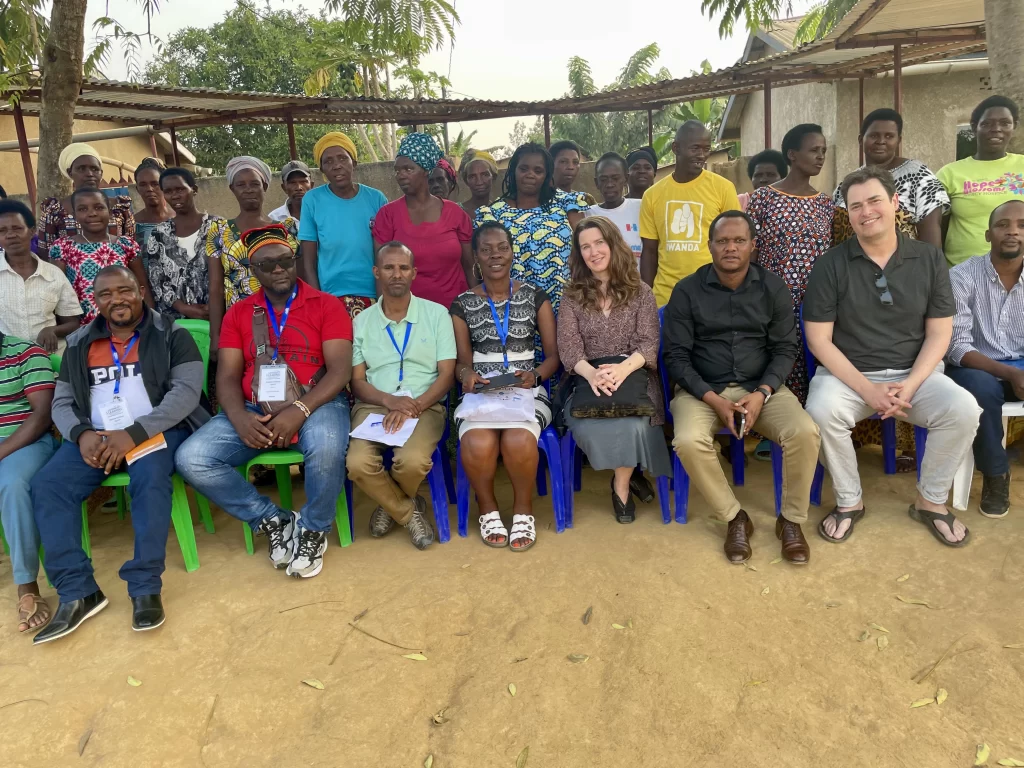
Laurence and Aloys After the Rwandan Genocide
Last summer I took part in a performance at a conference in Kigali, Rwanda. While I was in Rwanda, I was invited to visit a “reconciliation village.” These are planned communities that house victims of The 1994 Genocide Against the Tutsi alongside what Rwandans refer to as “perpetrators” – those that took part in the killing. Much of the violence in Rwanda was between neighbors, people who had known each other for a long time.
At the village I met Niyonagira Laurence and Mutiribambe Aloys. During the genocide, Laurence fled her village. She was pregnant at the time, and hid for days in the bush. Eventually Laurence grew so weak from thirst and hunger that she decided she would prefer to die quickly.
“I had no other choice,” Laurence said, speaking through an interpreter. “I ran to the roadblock [but] the soldiers refused to kill me. They said, ‘If we kill this woman, as we see her being pregnant, this will bring a curse for us. She will be killed by other people.’”
With few options, Laurence walked to Burundi to escape the violence. It was a brutal, harrowing journey, and she promised to devote her life to God if she survived.

Dr. Valentine Ngalim's Research on Forgiveness
Aloys told the visitors to his village that he was one of the perpetrators who killed members of Laurence’s family. He spoke openly and plainly about this, and asked the visitors to the village to share his story.
When the RDF (Rwanda Defense Force) finally ended the genocide, Aloys was arrested and imprisoned. He said that he expected to be killed for what he had done. Instead, after he served a number of years in prison, he was offered the chance to apologize to the families of people he had killed, and to ask for forgiveness. Though Aloys was skeptical, he wrote letters to Laurence and others in the village.
Laurence was not inclined to accept the apology she received from Aloys. However, at the time she was having terrible trouble sleeping. One sleepless night Laurence heard the voice of God, reminding her of the promise she made during the journey to Burundi. When Aloys finally arrived at the village, Laurence agreed to meet him. After many conversations, Laurence forgave Aloys.
But years later things became more complicated, when Aloys’ son fell in love with Laurence’s daughter.
“When I heard about his decision, I took it as impossible,” Aloys remembered. He told his son, Uwizeyimana Vedaste, “Laurence cannot give us her daughter.”
I visited the village with Dr. Valentine Ngalim, who studies forgiveness in Cameroon. He told me that he had never heard a story like this before.
“The sharing of experiences by victims and and culprits of the Rwandan genocide helped me to situate myself within the Cameroonian context,” Dr. Ngalim recalled. “I realized that in my context there is a lot of manipulation of truth, and the process of reconciliation is going to be very difficult.”

Love in the Shadow of Genocide: Solange and Vedaste
Laurence’s daughter, Uwizeyimana Solange, remembers how hard it was to understand the history of her country as a child. She said that it was during the community court proceedings, called Gacaca, that she finally understood who Aloys was.
“That’s when I came to learn the father of Vedaste has participated in the killing of my siblings,” Solange said.
Still, this knowledge did not prevent Solange from falling in love with Vedaste. When she was 16, Solange asked her parents’ permission to marry him. Laurence remembered this as the second hardest moment of her life, but eventually she assented.
For their marriage, Vedaste wrote a song and recorded it with the help of producers at a local studio. Solange loved the song, and asked him to write one about their village.
“I’m addressing myself to children of genocide perpetrators who are in a similar situation like mine,” Vedaste said. “I ask them not to be hostage to what their parents did, and envision a better future.”
The song is called “Imboni Y'ibyiza,” and it’s sung by Vedaste and Solange. You can hear it in the episode, and read a translation of the lyrics below.


English Translation of Solange and Vedaste's Song
Imboni Y'ibyiza
Let me praise the beautiful Rwanda,
Let me laud the good initiator,
Prison Fellowship you are the source of unity and reconciliation of Rwandans.
Be praised because of your many good deeds,
Prison Fellowship you are the initiator of the good social relationships we see in Rwanda.
I can see your good work, Prison Fellowship.
I was a seed growing in a direction different from its expected fruits,
I was like a bad seed removed from good seeds so that it may not spoil other seeds.
As the vineyard parable says everyone is responsible for his deeds.
Prison Fellowship you are the precursor of all good things.
Children of Rwanda are always valuable in rebuilding ourselves.
The Genocide perpetrated against the Tutsi was prepared with the utmost cruelty.
It was prepared and implemented by Rwandans who in the past used to have intermarriage and give to each other cows.
Since 1994 Tutsi have been persecuted.
In 1994 they were executed while the rest of the world was watching. But now Rwandans are reconciled.
Prison Fellowship your love for Rwanda is intense. You teach us asking for forgiveness and to forgive.
Live together children of Rwanda; the county flowing milk and honey.
Let us commit ourselves to unity and leave aside ethnic identities,
Children of Rwanda.
Let's again marry each orher.
Children of Rwanda let's live together without discrimination
Let 's work towards leading Rwanda into a bright future.
The value of true Rwanda is not to forget our history.
You Rwandans love your country.
Let unity, forgiveness and love be be abundant in Rwanda.
Related SongWriter episodes
- Freddy Mutanguha & Hope Azeda + Peace Jolis (Forgiveness)
- Helen Cho + Alison Mosshart (Caregiving/Forgiveness)
- Maggie Smith + Kat Edmonson (Caregiving)

Season seven of SongWriter is made possible by a grant from Templeton World Charity Foundation.
SUBSCRIBE ANYWHERE YOU GET PODCASTS
This project was made possible through the support of a grant from Templeton World Charity Foundation, Inc (funder DOI 501100011730, under the grant https://doi.org/10.54224/31681). The opinions expressed in this publication are those of the author(s) and do not necessarily reflect the views of Templeton World Charity Foundation, Inc.