
The Echo of Theodicy: Kaveh Akbar + Jamila Woods on Empathy, Friendship, and Song
Season 7, Episode 3
Kaveh Akbar and Jamila Woods share a creative friendship rooted in poetry, music, and a deep connection to human empathy. In this SongWriter episode, Kaveh shares a poem written for Jamila, Dr. Eman Abdelhadi explores questions of empathy and belonging, and Jamila responds with a brand new song called “Ordinary As Air.”

Kaveh Akbar’s Poem: Stumbling Through Guilt and Heartbreak
Bestselling author Kaveh Akbar was on stage at the storied Chicago venue, Metro. He had just read a brand new poem, titled “All of It,” that he wrote for his friend Jamila Woods. The poem is about empathy, and our conflicting sense of helplessness and responsibility in the face of the suffering in Gaza, Sudan, Ukraine, and in our own country.
“That sense of ‘How could you allow this?’ I’ve always felt like that question is an echo,” Kaveh said. “That question echoes back as an imperative, like, ‘How could you allow this?’ We are all, at this moment, allowing it.”
Like the main character in his novel Martyr!, Kaveh struggles with guilt, and perhaps at times questions his purpose as an artist. Still, while he was clear that art is not a sufficient response to suffering, Kaveh argued that it can help inform and grow our empathy.
“I do think that if one imagines empathy as a function of the imagination,” Kaveh said, “art can play a role in that imagination-expanding, giving us the reps we need to remember that every one of those numbers we were talking about was a human being who has a heart that could fit in your chest.”
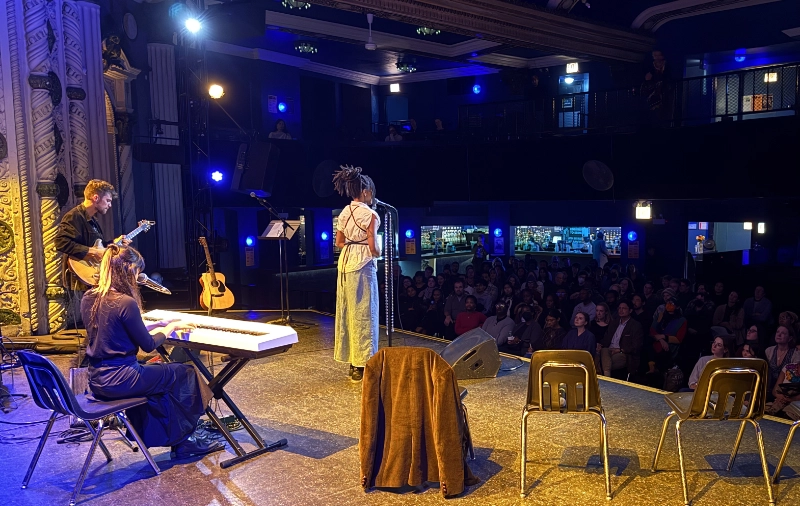
Jamila Woods’ Song: “Ordinary As Air”
At the show, Jamila performed a new song she wrote in response to Kaveh’s poem, and described her own struggle making art in response to profound suffering. Jamila said that the first song she wrote somehow didn’t feel sufficient. Listening back, she felt that it was more congruous with some of her older songs, and perhaps an older perspective.
“I realized that question of, like, asking to the sky ‘How could you let this happen?’ is not really alive in me anymore,” Jamila said. “I’m more looking into my own eyes in the mirror, looking at people around me, looking at humanity. Kind of: ‘What can we do here?’”
As well as a songwriter and an activist (the show benefited local non-profit A Long Walk Home), Jamila is also a poet. She said that sometimes it feels easier to represent suffering in poetry than music. Jamila thinks that her music, and especially her voice, can at times sound too soothing, too lyrical, to represent what she’s addressing. Yet Jamila is also conscious that she does not want to reflect or amplify violence and ugliness within her work.
“Finding a way to write about it, that is not just re-representing the violence I am trying to grapple with is something that I think is a little bit, not easier in poetry,” Jamila said. “[But] I don’t have to consider the sound of it in the same way.”

Dr. Eman Abdelhadi on Empathy, Community, and Belonging
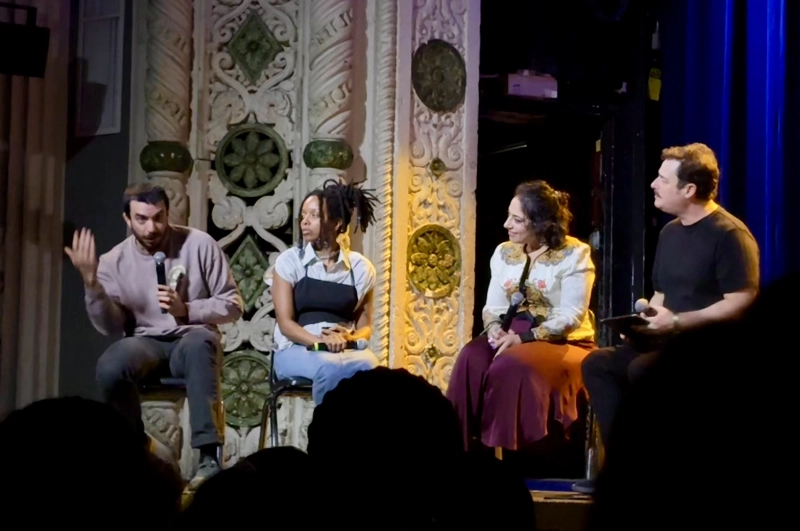
Dr. Eman Abdelhadi, who studies empathy at the University of Chicago, provided foundational context in the discussion. Dr. Abdelhadi said she understood Kaveh’s poem as addressing the sociological concept of alienation.
“You can see the starvation, you can see the horror, you can see the genocide,” Dr. Abdelhadi said. “And you can see that you are playing a role in it. And you can’t exit. You’re being told that you’re free but it doesn’t feel so free.”
Dr. Abdelhadi is also a writer. Her first novel, Everything for Everyone, is speculative fiction, envisioning a post-capitalist world. This envisioning, Dr. Abdelhadi believes, is a first step in the imaginative process of creating a better world.
When an audience member asked about holding on to empathy in the face of hate, Dr Abdelhadi encouraged people to see corrosive social structures, not people, as the enemy.
“Society is more than the sum of the individuals within it,” Dr. Abdelhadi said. “We exist in social structures. These structures exist independent of the individuals in them. So I think there’s a way to condemn the system and focus on changing these structures, while retaining as much empathy as we can for individual people. And understanding that people can be different in different circumstances. The enemy is the system that produces ICE, and it’s that enemy that we should be fighting.”
Related SongWriter episodes
- Helen Cho + Alison Mosshart (Caregiving/Empathy)
- Maggie Smith + Kat Edmonson (Caregiving)
- Polly Samson + David Gilmour

Season seven of SongWriter is made possible by a grant from Templeton World Charity Foundation.
SUBSCRIBE ANYWHERE YOU GET PODCASTS
This project was made possible through the support of a grant from Templeton World Charity Foundation, Inc (funder DOI 501100011730, under the grant https://doi.org/10.54224/31681). The opinions expressed in this publication are those of the author(s) and do not necessarily reflect the views of Templeton World Charity Foundation, Inc.